
Data Center Real Estate and the Growing Demand for Energy
By: Sanjay Guglani – Chief Strategy Officer, High Company LLC
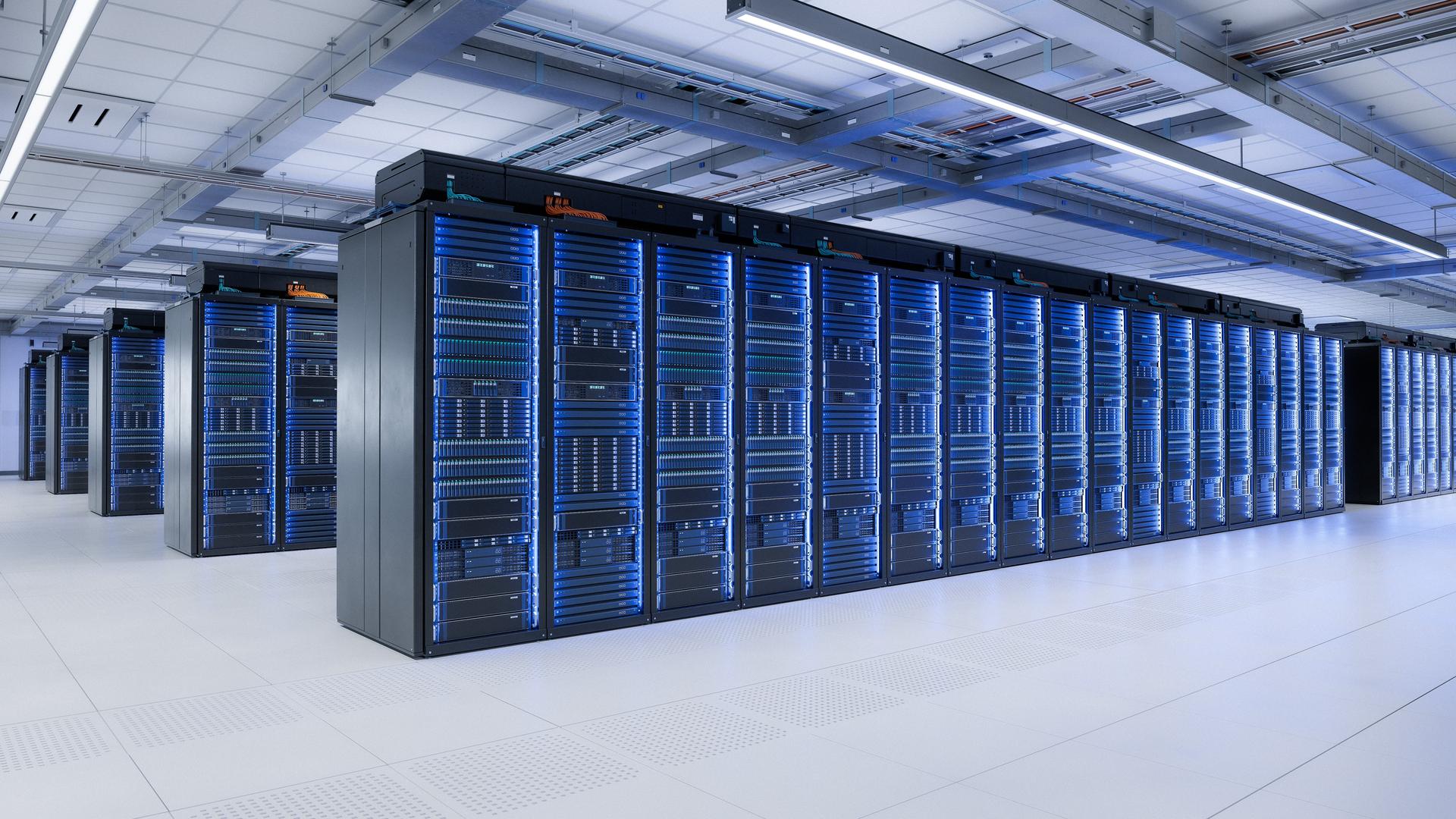
A data center (DC) is a facility that houses specialized computers, or servers, designed to store data and process information. Every time we save files to the cloud or conduct a web search, the servers performing those tasks are located in a data center.
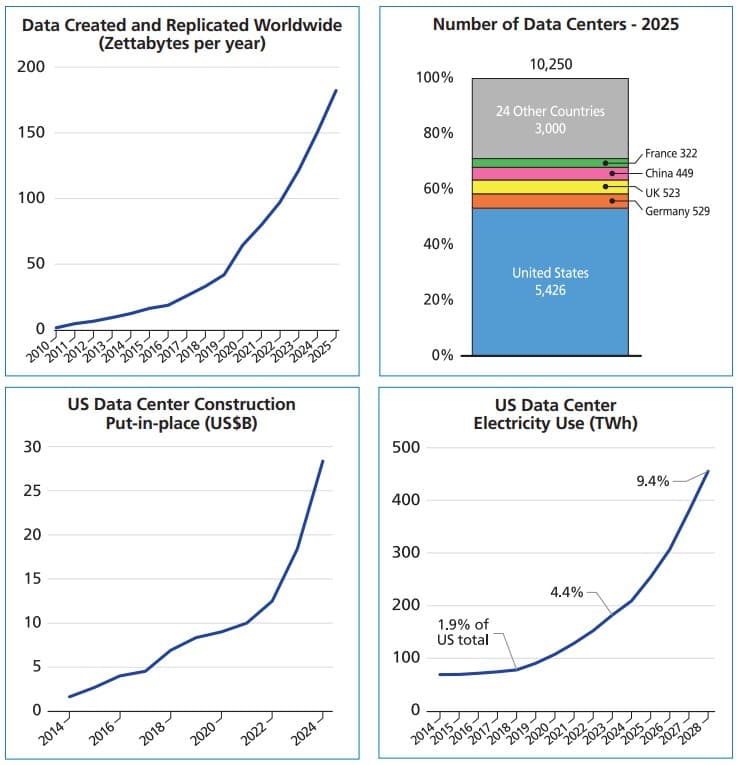
As data creation, cloud usage, and online activity continue to rise exponentially, data center real estate has become an increasingly important part of the U.S. commercial real estate landscape. The United States is home to more than half of the world’s data centers, and new facilities continue to be built to accommodate the growing need for computing power.
Data Center Real Estate: Scale and Commercial Footprint
Large data centers are typically developed as multi-building campuses. A single 100-megawatt (MW) data center is approximately 300,000 square feet in size and often includes six to 10 buildings. The rent for a 100-MW data center is about $600,000 per day.
This scale distinguishes commercial real estate data centers from many other property types. Their success depends not only on land and building capacity, but also on access to substantial, reliable power infrastructure. As a result, data center real estate investment requires careful consideration of site selection, utility capacity, connectivity, and long-term energy availability.
Data center construction trends are increasingly shaped by the need to deliver higher computing capacity while addressing power constraints. Developers and occupiers are evaluating locations through the combined lens of physical real estate, power availability, speed to market, and the ability to support future expansion.
Northern Virginia Data Center Real Estate: A Global Epicenter
Northern Virginia hosts the highest concentration of data centers worldwide. Northern Virginia data center real estate continues to illustrate both the opportunity and the infrastructure pressures created by this concentrated demand.
The scale of this industry is reshaping the region’s energy landscape, with data centers consuming more than 25% of Virginia’s electricity. The state is struggling to expand power supply quickly enough, with new facilities facing wait times of up to seven years for electrical connections.
For businesses evaluating data center real estate investment, this illustrates a critical reality: demand for digital infrastructure can outpace the power systems needed to support it. In high-demand markets, access to electricity may be as consequential as the availability of developable land.
The AI Impact on Data Center Demand
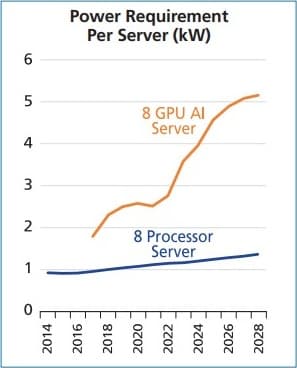
Artificial intelligence has supercharged demand for data centers. The AI impact on data center demand is driven by the computing intensity of training and operating AI models, which requires significantly more processing capacity than many traditional digital workloads.
AI servers consume significantly more energy than traditional servers. For perspective, an average ChatGPT query uses about 3 watt-hours of electricity, compared to about 0.3 watt-hours for a Google search.
This difference helps explain how AI is changing data centers. Facilities must be designed to accommodate denser computing environments and higher power requirements, while operators must continue to improve efficiency as demand for AI-enabled digital services grows.
Data Center Energy Consumption and Efficiency
How much energy do AI data centers use? The answer varies based on the type of AI workload, server configuration, cooling requirements, and facility design. However, AI workloads generally require more electricity than traditional computing tasks because AI servers operate at significantly higher levels of processing intensity.
The industry recognizes its energy-intensive nature and is investing heavily in efficiency. Advances in server design, chip technology, and AI model optimization aim to reduce data center energy consumption while meeting the growing demand for digital services.
Energy efficiency will remain a defining consideration for organizations investing in digital infrastructure real estate. The ability to support high-density computing efficiently can influence operating costs, development feasibility, and the long-term value of a data center asset.
The Future of Data Center Development
The continued growth of data center real estate reflects the broader expansion of the digital economy. As cloud computing, AI, and data-intensive services advance, the sector will face a dual challenge: providing the capacity businesses need while managing the energy demands required to deliver it.
For developers, investors, and corporate real estate leaders, this means aligning real estate strategy with power strategy. The most competitive markets and projects will be those that can balance development capacity, energy availability, operational efficiency, and long-term scalability.
FAQs About Data Center Real Estate and Energy Demand
1. What is data center real estate?
Data center real estate includes the land, buildings, campus infrastructure, and related facilities that support the storage, processing, and transfer of digital data. Unlike many traditional commercial property types, data centers require substantial and reliable electrical capacity, connectivity, and specialized mechanical systems.
2. Why is data center energy consumption increasing?
Data center energy consumption is increasing because digital services, cloud computing, data storage, and AI workloads require growing amounts of computing power. AI applications are particularly energy-intensive because the servers that train and operate AI models use more power than traditional servers.
3. How much energy do AI data centers use?
Energy use varies by the facility, AI workload, hardware, cooling system, and operating conditions. However, AI servers consume significantly more electricity than traditional servers. For example, the supplied source content estimates that an average ChatGPT query uses approximately 3 watt-hours of electricity, compared with about 0.3 watt-hours for a Google search.
4. How is AI changing data centers?
AI is changing data centers by increasing demand for high-density computing capacity and electricity. This requires facilities to support more powerful servers, advanced cooling systems, and improved energy-efficiency measures while maintaining reliable operations.
5. Why is Northern Virginia important to the data center market?
Northern Virginia is the world’s largest data center market by concentration. Its scale has made it a leading example of how rapid data center growth can reshape local real estate and energy infrastructure, including demand for utility capacity and electrical interconnections.
6. What should decision-makers consider before investing in digital infrastructure real estate?
When investing in digital infrastructure real estate, decision-makers should assess factors including power availability, utility connection timelines, site suitability, connectivity, scalability, energy efficiency, and local market demand. These considerations are central to the feasibility and long-term performance of a data center project.